Presented by Allison Campbell, PhD
Click to listen to the professional sketch from the service (Allison starts at about 1:14).
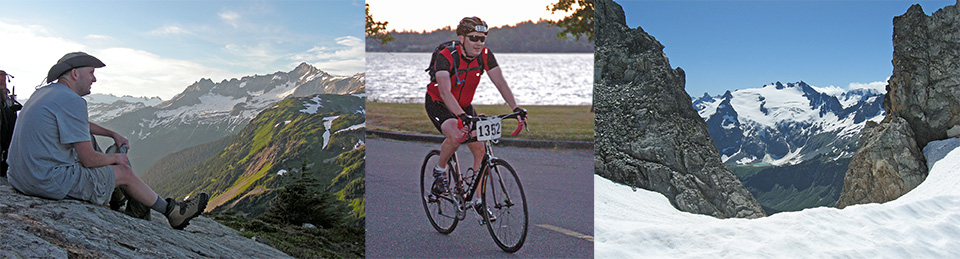
My name is Allison Campbell and I am the Director of the Environmental Molecular Sciences Laboratory at the Pacific Northwest National Laboratory. Like Jared, I am a fellow cyclist. Today I picked a jersey with a mountain on it to honor both his riding spirit and his love of the outdoors. I’ve thought a lot about Jared since that fateful day last month, particularly when I am out on my long rides, and thought a lot about how to describe his work life. So what I thought I would do is describe to you what he did and the impact he had, not just on the laboratory but the world. To do that I have to take a minute and explain what we do at the lab.
EMSL is a national scientific user facility. It is our mission to provide computational and experimental resources to scientists around the world to do their science. Jared was a member of our Molecular Sciences Operation Computing group. He was responsible for operating our supercomputer at the laboratory. This a big huge supercomputer, think of it as thousands of individual computers wired together to form one massive system.
I walked in to his office yesterday to spend some time, it is preserved as it was the day he left it, and in his office he has four monitors. I think he took after his father-in-law. He treated the supercomputer as a doctor to a patient. He monitored that system in every way feasible. He knew that system inside and out. He knew when it was going to go down, he knew how to prevent mishaps, and he knew how to keep it operating at peak performance. That’s vital for us to ensure our mission to provide these resources.
Apparently this was a man who loved monitors, so the more monitors he could have in his office the better. He had a screen up there looking at processor speeds, he had a screen up there looking at how the memory was used on the computer, he had a screen looking at the communication between the processors, and so on and so forth. He really knew that system and we relied on him to keep it up and going. And I’ll give you a couple of examples of how he was able to really bring that system to life.
When we first put that system on the floor a few years ago, the InfiniBand, which is the communication system between processors, wasn’t working appropriately. The way that the jobs get put on that system is that they get parsed out to all these processors and so there has to be communication between all the different parts of the computer and we want that to be as fast as possible. It wasn’t working and the vendor in this case could not figure out how to fix the problem. Jared did. Didn’t take him long, he solved the problem. The vendor couldn’t, he did. Huge impact for us.
A year or so ago, the tsunami hit Japan. We all saw it unfold on the news. That tsunami, while it affected thousands and thousands of people’s lives, also affected the science that the Japanese scientists could do. So we at EMSL decided to help them out and put their science projects on our supercomputer. It’s a very different kind of science than what we historically do on our system and it required some unique things to be done. People didn’t think that we were going to be able to do that. Jared didn’t see a problem, he figured it out, he got their systems up and running on our system.
In fact, we had some visitors from the Japanese scientists as well as the part of the Department of Energy that was sponsoring this program come by and we were describing how efficiently these codes were running on our system. All eyebrows shot up, they couldn’t believe it. This was because of Jared and his ingenuity, his smarts, his intelligence and his hard work that got that up. Basically it was keeping the science programs going in Japan.
He was always willing to contribute in ways, even outside his normal duties. There is a large picture of Jared working on the supercomputer [below], he’s wearing a nice bright blue shirt. He hated that shirt. Jared didn’t like to have his picture taken. What happened was someone didn’t show up for a photo shoot featuring our supercomputer and he stepped right in, put on the blue shirt and, more than that, put on makeup, to have his photo taken so that we could show not only the computer but the expert staff that operate that system. I think he wore the makeup home just to show you [Kelley], is that correct?
So he kept this machine up and running and his impact was worldwide. The scientists use that system to design new catalytic material to help clean up the environment. They use that system to understand how contaminants migrate through the subsurface and control, predict, and mitigate that migration. They use that to understand and identify biomarkers for diseases, like Parkinson’s, Alzheimer’s, various forms of cancer. They do that because Jared kept that machine up and running for them. And without him, there is no supercomputer. Without him and members of his group, there is no science. Without him, our mission is not fulfilled.
So in closing I think I want to sum up his contribution in terms of a few numbers. The first number is 600+. That’s the number of scientists who have used the system since Jared came on board in 2006. 500+ is the number of scientific research projects that have been done on that computer because it’s pretty much been operational since its inception because of Jared. Those projects have resulted in hundreds of scientific publications that are read by scientists around the world. 34 is the number of countries that scientists have come from to use that system, so you can see that his impact was worldwide, not just in Richland, not just in Washington, Oregon, but around the world.
In fact, when I heard about his death I had just returned from China and I sent a note to one of my colleagues back there who actually had worked with Jared to port up his codes and make them run efficiently. He told me how great Jared was, how he had worked with him off hours because of the time difference to really help get that code up and running. He was all about enabling science, helping the researcher.
Finally, the last number, 1. A life tragically taken too soon. It is profoundly sad and incredibly tragic. I can tell you that the family at EMSL, the family at the Pacific Northwest National Laboratory, grieves with you. I particularly think of EMSL as a family. We have lost one of our own. He will be missed locally, he will be missed internationally. On behalf of the EMSL family, I offer you, Kelley, my condolences, and to the rest of the family. On a personal note, it’s for me especially sad learning about Jared in his life but also in his death and all of the things that we had in common. The love of cycling, the love of the outdoors, bicycles, motorcycles, camping, dogs. He will be missed. Thank you.

 Jared F. Carr